
Buyer Guide / 5 min read
How to Verify a Smart Toilet Factory: A Buyer's Checklist
Verify a smart toilet factory before ordering: documents to request, certifications to check against official records, QC signals, and B2B red flags.
Key takeaways
- Verify a factory in three layers: documents first, then certifications, then how production and QC actually run.
- Check a certificate's number, model scope and product type — a certificate for a remote does not cover the whole toilet.
- Ask for test records and a floor or live-video audit; a showroom-only visit is a warning sign.
- Match certificates to the exact models for your market, and check what is not certified as well as what is.
B2B sourcing checklist
Move from research to a model-specific quotation
Use the resources below to confirm specifications, compliance scope, order terms and delivery timing before requesting a quote.
Verifying a smart toilet factory is not one inspection. It is three checks in sequence: check the documents, check the certifications, and check how the factory actually produces and supports its products. Do all three before a first order, and you filter out most sourcing problems before they cost you money.
A factory that can back a claim with a document you can check is rare and worth keeping. A factory that offers only video tours and verbal promises needs more evidence. This guide walks through the exact sequence we use with bathroom distributors, and names the specific records to ask for at each step.
Start with documents, not a quote
Request these before you discuss price:
- Business license. The registered company name must match the entity you will sign with. Check that the business scope covers manufacturing, not only trading.
- Export evidence. Ask for shipment records or bills of lading to your market. Past exports show a factory can actually ship there.
- A model list for your market. Ask the factory to name which models target your market. Reject “all our products are certified” — a certification is model-specific.
- A QC flowchart and an inspection report template. A factory that has both can show how and when it inspects.
- Warranty, spare parts, MOQ, lead time and capacity in writing.
A genuine manufacturer can explain the full route: raw material, forming, firing, assembly, inspection, packing. A trading company usually cannot go past “we have many products.” If a supplier will not put documents on the table, that is the first red flag, not the last.
Verify certifications against the records, not the wall
A certificate on a wall tells you little. Three checks decide whether a certificate is useful for your order:
- The certificate number exists in the issuing body’s records.
- The models listed on the certificate include the exact model you want.
- The certificate covers the product type you are buying — a smart toilet, not just a remote control.
Certificates are scope-sensitive. Two examples from our own records: the A17 and A18 carry the cUPC/IAPMO file 11670 and the UL reference E527307, and both require matching the model against the listing pages and the current directory before an order. The FCC ID 2A558GC337894 covers the remote transmitter only, not the complete smart toilet. So ask any factory: “Does this certificate cover the complete unit, or a component?”
That last question matters more than it looks. An FCC authorization for a remote control does not make the whole toilet compliant, and a supplier who lists it as a “toilet certification” is either sloppy or misleading. The reverse also happens: the B04 bidet seat is covered by an FCC Supplier’s Declaration of Conformity across the B041 family, which is real but still only covers that defined model range.
Also check what is not certified. In our records, WaterSense is not held, LEED is a building certification rather than a product one, and the ISO 9001 statement has no certificate file behind it. None of that is unusual — but it should be stated plainly, not implied. The full breakdown of cUPC, UL and FCC listings explains how to read each one.
What to ask before a factory visit
A visit is most useful when you already hold the documents. Ask six questions:
- Do you fire your own ceramic bodies, or buy them in?
- Do you make the electronics in house, and who supplies the PCBs?
- Where are your QC checkpoints, and what is tested per unit versus per batch?
- Can you share test records — water pressure, flush, overheat protection, nozzle cycles?
- Which spare parts do you keep in stock, and how fast can you ship them?
- Which models carry documents for my market, and can I see those files?
The questions do two jobs. They test technical depth, and they test honesty. A supplier who cannot say who makes the PCB cannot support the electronics after the order.
What good production and QC look like
Look for controls at three stages: incoming material, in-process, and finished goods. The strongest signals are records, not facilities:
- Per-unit functional testing — water pressure, flush performance, heating and overheat protection — recorded for finished units.
- An acceptance sampling plan you agree to in writing before production starts.
- A QC stamp or checklist on finished bowls, so seconds do not slip into a commercial shipment.
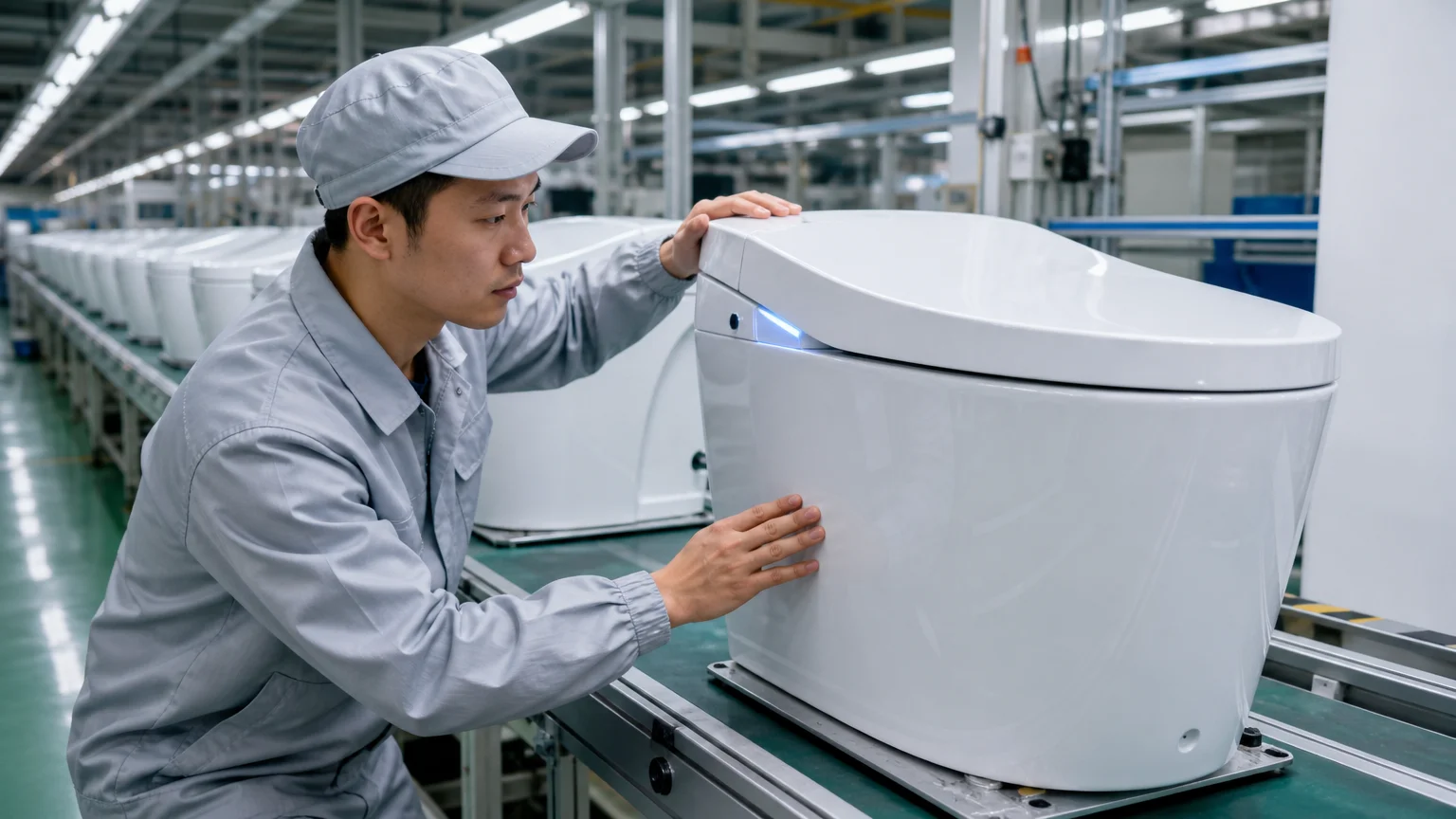
See the floor, not just the showroom. If the first hour of a visit is spent in a showroom and the production floor is “not ready today,” treat that as a warning. A live video audit works too: ask to see a specific area in real time — assembly, the test station, packing — rather than a recorded tour.
If you cannot visit, a third-party pre-shipment inspection (SGS, Bureau Veritas, Intertek, QIMA) is the standard alternative, usually charged per man-day. It does not replace the document and certification checks; it confirms the finished goods match them.
Red flags in B2B sourcing
- The supplier cannot say clearly whether it is the factory or a trading company.
- “We can provide any certificate you need,” but no model-specific files follow.
- No certificate numbers, or numbers that do not survive a search.
- Prices so low they cannot cover the bill of materials.
- Vague warranty, spare parts or after-sales terms.
- Slow or evasive answers to technical questions.
- Claims of capacity or lead time with nothing behind them.
Any single red flag is worth a follow-up question. Two or more is a reason to pause the sourcing process.
A verification checklist you can use
Run this list for every shortlisted factory before an order:
- Documents: the license matches the signing entity, export evidence, a model list, a QC flowchart, written warranty and MOQ terms.
- Certifications: numbers exist in official records, models are covered, and the product type matches the unit you buy.
- Production: QC checkpoints at three stages, per-unit test records, a floor or live-video audit, and a third-party inspection option.
- Terms: a clear MOQ and lead time (we quote a single unit at factory wholesale price with no MOQ), spare parts, and an after-sales response you can test.
Send the completed checklist and your target market to our distribution team, and we will confirm which models and records match before you commit. Start with the smart toilet category, or download the technical documentation to compare what a factory should be able to produce.
Related pages
Referenced models
Products discussed in this article
A17 Integrated Smart Toilet
U-shaped integrated smart toilet with siphon jet flushing, foot-sensor operation and a full comfort function set — CUPC, UL and FCC certified for the North American market.
View specifications Smart ToiletA18 Integrated Smart Toilet
A17 sibling with microwave-sensing auto lid and foot-sensor operation — adds hands-free open/close for hospitality and premium residential use.
View specifications Bidet Toilet SeatB04 Electric Bidet Seat
Elongated electric bidet seat with side-knob washing control, soft-close lid and model-dependent warm-air drying.
View specificationsNext step
Send us the project details
Share the market, quantity, site conditions and documentation you need. Our technical team confirms configuration and compliance scope before anything is quoted.