
Buyer Guide / 23 min read
How Much Does a Smart Toilet Weigh? Weight & Shipping Guide
How much does a smart toilet weigh? Compare actual model weights, net vs gross weight, packaging dimensions, safe handling and delivery requirements.
Key takeaways
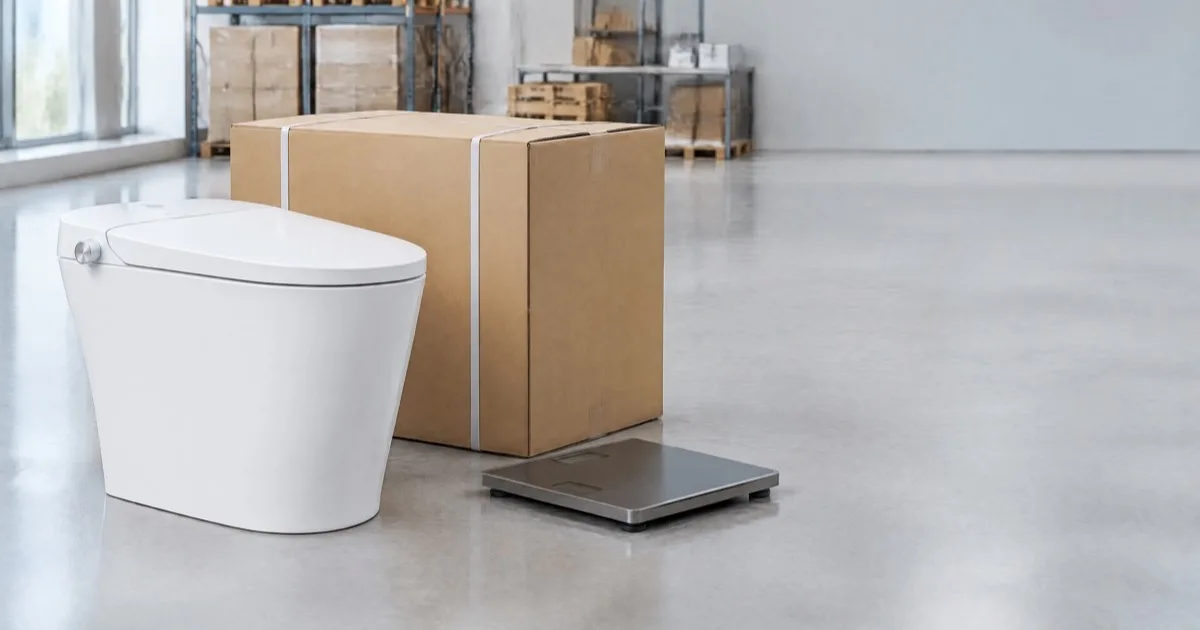
- Lavilys A17 and A18 each have a documented net weight of 39.5 kg (87.1 lb) and a packaged gross weight of 44.5 kg (98.1 lb).
- Net weight matters for installation handling; gross weight and carton dimensions matter for freight, receiving and storage.
- The A17 and A18 shipping carton measures 825 × 585 × 575 mm, or approximately 0.278 CBM per unit.
- An 87 lb ceramic fixture with electronics should be planned as a team lift or with suitable mechanical handling, not as a one-person carry.
B2B sourcing checklist
Move from research to a model-specific quotation
Use the resources below to confirm specifications, compliance scope, order terms and delivery timing before requesting a quote.
How much does a smart toilet weigh? A smart toilet is a ceramic fixture with electronics, a heated seat, a washing system and, depending on the model, a tank or assisted-flushing mechanism. That combination makes it heavier and more awkward to handle than a conventional toilet seat or a simple two-piece toilet.
The practical answer for the Lavilys range is straightforward: the documented A17 and A18 integrated smart toilets each weigh 39.5 kg (87.1 lb) net and 44.5 kg (98.1 lb) gross in their shipping carton. The W1 has a documented net weight of 39 kg (approximately 86 lb); its packaged gross weight must be confirmed for the specific order because it is not published as a standing figure.
Those numbers answer the search question, but they are only the starting point. A buyer also needs to know which weight applies to the installation crew, which weight applies to the freight quote, how much space the carton occupies, and what happens when a 100-unit project arrives at a loading dock with limited access.
This guide separates those questions. It covers real model weights, the difference between net and gross weight, packaging volume, safe handling, delivery planning and the documents a professional buyer should confirm before shipment.
For the separate questions of rough-in, voltage and water pressure, use the smart toilet installation requirements checklist. This article stays focused on weight, packaging and logistics.
How Much Does a Smart Toilet Weigh?
There is no single weight for every smart toilet. The answer depends on the ceramic body, the electronic bidet system, the flushing architecture, the lid mechanism and the overall product dimensions.
For the integrated models documented in the Lavilys catalogue, a complete smart toilet weighs approximately 39–39.5 kg (86–87.1 lb) before packaging. That is a product-range observation, not an industry-wide rule. Compact models may weigh less; larger fixtures with different internal structures may weigh more.
The important distinction is between the product and the shipment:
- Net weight describes the toilet itself, without the carton and packing materials.
- Gross weight describes the packed unit as defined by the supplier’s packing specification.
A freight quote based on net weight will underestimate the load. An installation plan based only on gross weight will overstate what the crew handles after unpacking. Both figures are useful, but they answer different questions.
Real smart toilet weight examples
The table below uses published Lavilys product data for three integrated models. It is intended to show how documented weights vary within one range, not to establish a universal benchmark.
| Model | Net weight | Gross weight | Product dimensions |
|---|---|---|---|
| A17 | 39.5 kg / 87.1 lb | 44.5 kg / 98.1 lb | 680 × 390 × 460 mm |
| A18 | 39.5 kg / 87.1 lb | 44.5 kg / 98.1 lb | 680 × 390 × 460 mm |
| W1 | 39 kg / approximately 86 lb | Confirm before shipment | 680 × 400 × 470 mm |
Published specifications for the current Lavilys range. Final weight and packing details must be reconfirmed for the selected model, configuration and order.
The A17 and A18 share the same documented body dimensions and weight, even though the A18 adds automatic lid operation. The W1 is slightly lighter and slightly deeper in its body dimensions, and its rough-in options differ.
A buyer should not assume that the smallest-looking model is the lightest, or that two models with similar dimensions will have identical packed weights. Package design, accessories and carton construction can change the shipment even when the toilet body is similar.
For current model options, see the Lavilys integrated smart toilet collection.
Why Are Smart Toilets So Heavy?
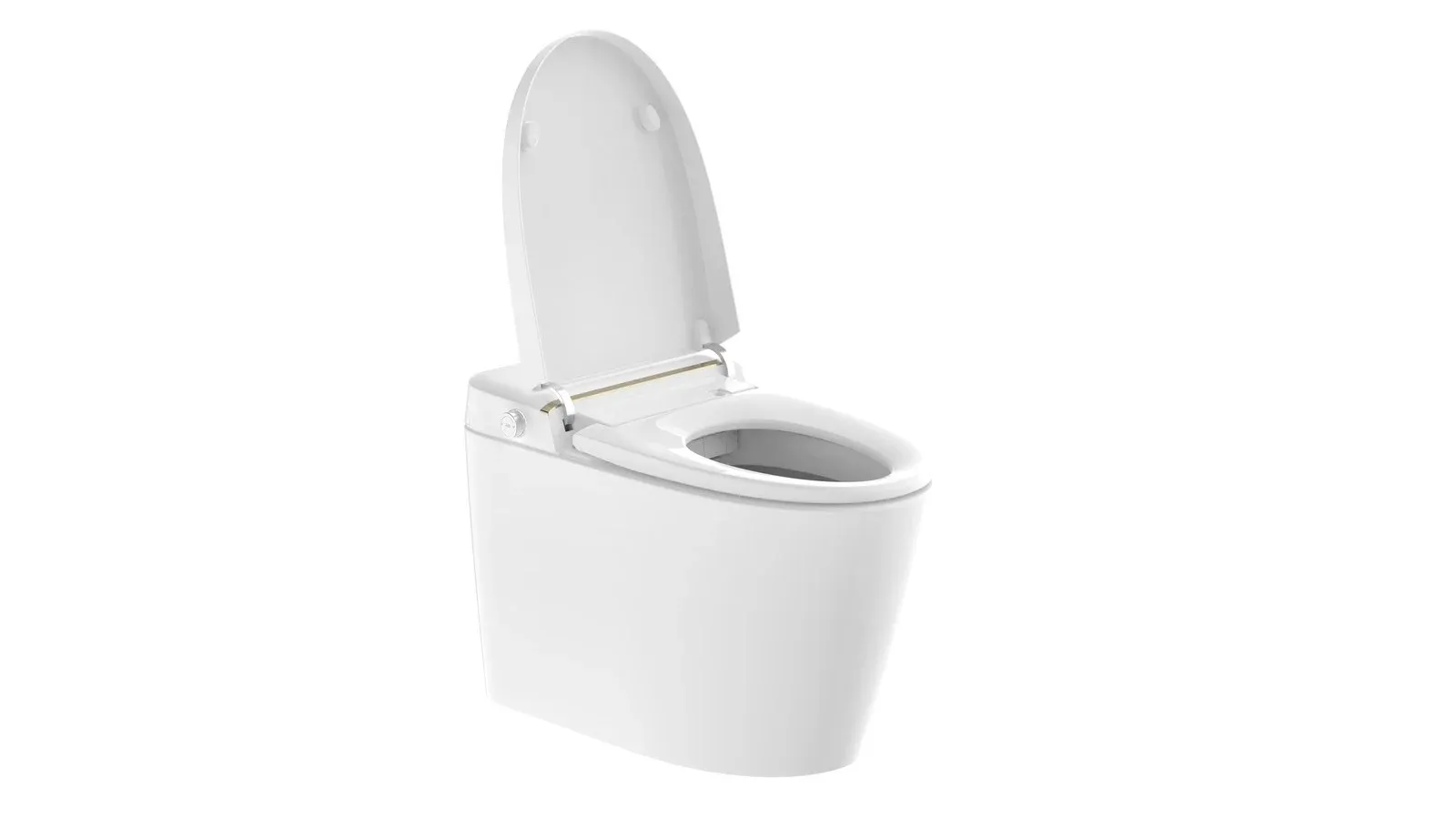
The weight comes from several systems working together. It is not just a ceramic bowl with a small electronic seat attached.
1. The ceramic body
Sanitary ceramic is dense, rigid and resistant to impact and moisture. A one-piece integrated toilet uses a substantial ceramic structure to support the seat, lid, bowl and internal components while maintaining a stable footprint.
The ceramic body is usually the largest single contributor to net weight. It also makes the product fragile during handling: a concentrated impact can crack or chip a surface that looks solid.
2. The electronic bidet system
An integrated smart toilet typically includes:
- A retractable washing nozzle and its carriage
- Water-control valves and a diverter
- An instant water heater or heated-water module
- Control circuit boards and sensors
- A heated seat element
- A warm-air drying fan and heater
- Wiring, connectors and a power supply
Individual components are small, but together they add mass and, more importantly, they change the center of gravity. The electronic parts also must be protected from water, impact and flexing during transport.
3. Flushing components
Different models use different flushing architectures. A tankless or concealed-tank design may use a pump, pressure-assisted valve or internal water-storage components. A conventional tank-in-ceramic design uses a different set of parts.
A toilet without an exposed tank is not automatically lighter. Internal reservoirs, pumps, valves and reinforced ceramic passages can add weight while keeping the outside profile compact.
4. Automatic lid and motor components
Models with automatic lid operation add a motor, gear mechanism, position sensors and a control interface. The A18 includes microwave-sensing automatic lid operation in addition to its washing and comfort functions.
These parts are relatively light compared with the ceramic body, but they are vulnerable to force applied in the wrong direction. Lifting the toilet by the lid or forcing the lid closed during unpacking can damage the mechanism even if the ceramic survives.
5. Product design and structural requirements
Ceramic thickness, internal supports, the bowl shape and the mounting system all affect weight. Two toilets can look similar in a showroom and still differ by several kilograms once the internal structure and electronics are included.
That is why model-specific documentation matters more than a generic category estimate.
Smart Toilet Net Weight vs Gross Weight
The difference between net and gross weight is small in absolute terms but important in planning.
What is net weight?
Net weight is the weight of the product itself, excluding the shipping carton and packing materials. For the A17, the documented net weight is 39.5 kg (87.1 lb).
This is the figure an installation team should use when planning how to lift and position the fixture after unpacking. It is not the weight of the carton that arrives at the loading dock.
What is gross weight?
Gross weight includes the product and the packaging defined in the supplier’s packing specification. That may include the outer carton, protective inserts, accessories and documents.
For the A17, the documented gross weight is 44.5 kg (98.1 lb). This is the figure to use for freight planning, manual handling at receiving and storage load calculations.
Example: A17 weight breakdown
| Item | Weight |
|---|---|
| Product net weight | 39.5 kg |
| Packed gross weight | 44.5 kg |
| Difference | 5.0 kg |
The 5.0 kg difference is the additional weight accounted for in the published gross-weight figure. It should not be treated as the precise weight of an empty carton, because the packing specification may also include accessories and protective materials.
Why the difference matters for buyers
A distributor ordering 20 units of a model with a 44.5 kg gross weight is arranging handling for:
20 × 44.5 kg = 890 kg
That figure excludes pallets, strapping and any additional logistics equipment. Using the 39.5 kg net weight instead would understate the load by 100 kg across the order.
For a 100-unit apartment project, the same carton weight becomes:
100 × 44.5 kg = 4,450 kg
That is before pallets and before any allowance for staging, damaged-unit replacement or packaging disposal. At this scale, the difference between net and gross weight is no longer a rounding error; it affects vehicle selection, dock scheduling and temporary storage.
Smart Toilet Packaging Dimensions: Why Size Matters as Much as Weight
Freight cost and handling difficulty depend on both weight and volume. A ceramic toilet needs a carton large enough to protect the body, lid, accessories and connections.
The A17 and A18 share the following documented dimensions:
| Measurement | Product | Shipping package |
|---|---|---|
| Length / first listed dimension | 680 mm | 825 mm |
| Width / second listed dimension | 390 mm | 585 mm |
| Height / third listed dimension | 460 mm | 575 mm |
The shipping package is larger than the product because it must accommodate protective inserts, accessories and handling clearance. The orientation of the carton and the meaning of each dimension should be confirmed against the approved packing drawing before a container plan is finalized.
If the carton is being customized for a private-label program, the packaging change can affect both gross weight and carton dimensions. The private label smart toilet OEM guide covers how packaging, branding and production scope are approved.
How to calculate carton volume
Freight planners often use cubic meters (CBM) to estimate shipment volume:
CBM = length (m) × width (m) × height (m)
For the documented A17 carton:
0.825 × 0.585 × 0.575 = approximately 0.278 CBM per carton
For 20 cartons:
20 × 0.2775 = approximately 5.55 CBM
This is the sum of the individual carton volumes. It does not account for pallet overhang, spacing between cartons, loading restrictions, access aisles or the fact that cartons may not fill every part of a container. It is a planning figure, not a container-loading approval.
Why freight charges may differ from the carton weight
Carriers do not always charge on gross weight alone. Depending on the service, a shipment may be rated on actual weight, dimensional weight, volume, freight class or a combination of rules.
For parcel and air shipments, dimensional weight can make a large, relatively light carton more expensive than its scale weight suggests. For less-than-truckload (LTL) freight, density and freight class can affect the rate. For ocean freight, volume and contractual terms may matter more than the weight of a single carton.
Do not assume that a 44.5 kg carton will always be charged at exactly 44.5 kg. Ask for a quote using the packed dimensions, gross weight, origin, destination and service level.
Is a Smart Toilet Heavier Than a Regular Toilet?
Not automatically. Conventional toilets vary widely in size, ceramic thickness and whether they are one-piece or two-piece designs. A large one-piece conventional toilet can be substantial, while an integrated smart toilet may use a more compact ceramic body.
The useful comparison is between actual products, not categories.
| Product type | Main weight considerations |
|---|---|
| Two-piece conventional toilet | Bowl and tank are separate; the pieces may be handled individually |
| One-piece conventional toilet | Integrated ceramic body handled as one unit |
| Integrated smart toilet | Ceramic body plus washing, heating, drying and control components |
| Electronic bidet toilet seat | Electronic seat assembly installed onto a compatible existing toilet |
An electronic bidet seat is generally much lighter than a complete ceramic toilet because it does not include the bowl and floor-mounted body. For a renovation where the existing toilet is compatible, replacing only the seat can reduce the amount of heavy ceramic equipment that must be transported and installed.
That does not make a bidet seat the right choice for every project. The existing toilet must be compatible, the electrical supply must be suitable and the user must accept the seat-mounted form factor. The bidet seat vs integrated smart toilet comparison covers those trade-offs, and the electronic bidet seat range shows the lighter seat-mounted option.
Can One Person Lift and Install a Smart Toilet?
A 39.5 kg (87.1 lb) toilet is difficult to handle safely, even for a strong installer. The problem is not only the number on the scale. The fixture is bulky, has an uneven center of gravity, offers limited grip points and contains fragile ceramic and electronic parts.
A planned team lift or suitable mechanical handling is usually the safer approach. The exact method depends on the site, the route, the available equipment and the employer’s safety procedures.
NIOSH’s ergonomics guidance on lifting and work-related musculoskeletal disorders explains why awkward loads, repetitive handling and poor grip increase injury risk. A ceramic toilet combines several of those risk factors.
Why ceramic toilets need careful handling
Ceramic can crack from impact or concentrated pressure. Damage may not be visible immediately, especially around the base, the trapway or the mounting holes. A fixture that survives the delivery may fail after installation if a hairline crack opens under load.
Electronic components add a second failure mode. A dropped toilet may power on but develop sensor, lid or washing faults later. For a retailer or project buyer, that becomes a warranty and scheduling problem rather than a single damaged carton.
Handling precautions
Before moving a smart toilet:
- Read the manufacturer’s handling and installation instructions.
- Inspect the carton for crushing, punctures, water damage or signs of dropping.
- Confirm the delivery route before unpacking.
- Use suitable lifting equipment or enough trained personnel.
- Keep the product supported in the approved orientation.
- Protect the ceramic body from impact.
- Do not put pressure on the lid, seat or control panel.
- Do not lift the product by its power cord, water hose, remote or motorized lid.
- Do not use a component as a lifting point unless the manufacturer explicitly identifies it for that purpose.
How to Move a Smart Toilet Safely
The following sequence describes general handling considerations. It does not replace the model-specific installation manual or the site’s safety plan.
Step 1: Inspect the carton before moving it
Check for crushed corners, punctures, moisture damage, torn strapping and signs that the carton has been dropped or stacked incorrectly. Photograph any visible damage before moving the product further.
If the carton is wet or severely deformed, do not assume the contents are intact. Isolate the unit and contact the supplier or carrier according to the delivery terms.
Step 2: Plan the route
Measure doorways, hallways, stairwells, elevators and turns. The 825 × 585 × 575 mm A17 carton is substantially larger than the toilet body, and a route that fits the installed fixture may not fit the box.
For upper-floor deliveries, confirm elevator capacity and whether the carton can be angled through the door. For basement or split-level homes, check stair width and landing space.
Step 3: Choose the handling method
Select equipment and personnel based on the packed weight, shape and route. A pallet jack may work on a loading dock but not on a finished hardwood floor. A stair-climbing hand truck may help on one site and be unsuitable on another.
Use protective floor coverings and avoid dragging the carton. Do not remove the carton in a hallway or on a staircase where the unwrapped ceramic could fall.
Step 4: Unpack in a controlled area
Open the carton in a clear, protected area. Follow the manufacturer’s unpacking sequence and keep the ceramic unit supported.
Do not pull the toilet out by the lid, seat or electronic attachments. Remove accessories and packing materials before lifting the body, and keep small parts with the unit.
Step 5: Inspect before installation
Check the ceramic body for cracks, chips and missing glaze. Confirm that the seat, lid, control components and visible plumbing connections are intact. Compare the accessories with the packing list.
If significant damage is found, do not install or power the product. Report the issue to the supplier with photos and receiving records.
Does Smart Toilet Weight Affect Installation?
Weight matters, but it is only one part of installation planning. The floor structure, mounting method, wall support, rough-in and electrical supply all affect whether a model can be installed.
Floor-mounted smart toilets
The A17 and A18 are floor-mounted integrated toilets. They rest on the bathroom floor and connect to the drainage and water supply. The finished floor and mounting arrangement must be suitable for the fixture.
The net weight is not the same as the load imposed during use. The installation must also accommodate the user and meet the applicable structural and installation requirements. For a renovation, a contractor should confirm the subfloor and mounting conditions rather than assuming that the old toilet’s footprint is adequate.
Wall-hung smart toilets
Wall-hung models transfer load to a carrier, frame and wall assembly. The anchors, wall structure and installation method must be designed for the intended loads.
A wall-hung model cannot be approved by comparing its net weight with a floor-mounted toilet. The complete supporting system matters.
Rough-in compatibility
Rough-in is the distance from the finished wall to the center of the drain. A model with the right weight and dimensions can still be impossible to install if the drain location is wrong.
For reference:
- A17: 305 mm rough-in
- A18: 305 mm rough-in
- W1: 300 mm or 400 mm rough-in options
Confirm the rough-in before ordering, especially for a showroom range that will be sold into older homes with varied plumbing. The installation requirements guide covers the full checklist.
Smart Toilet Shipping: Parcel, Freight or Container?
The right shipping method depends on quantity, destination, product availability and how much handling the buyer can manage at the receiving end.
Individual showroom units
A retailer may need one unit for display or customer evaluation before committing to a larger order. For eligible models available in US warehouse stock, Lavilys supports one-unit pilot or showroom orders.
The selected service must accommodate the carton dimensions, weight and fragile ceramic contents. A single unit may move through a parcel or small-freight service, but the buyer should confirm the carrier’s weight and size limits, liftgate, appointment and inside-delivery options rather than assuming curbside service is sufficient.
Palletized shipments
For multiple units, palletizing can simplify loading and receiving. The pallet plan must account for carton orientation, product protection, load distribution, stacking limits and carrier requirements.
Not every carton is suitable for unrestricted stacking. A carton that protects one unit in a parcel network may need additional edge protection or a different pallet pattern for LTL freight.
Container shipments
Large distributors and project buyers often use containerized ocean freight. Planning should include:
- Total units and model mix
- Gross weight per carton
- Carton dimensions and CBM
- Pallet configuration
- Container loading plan
- Destination port and inland delivery
- Insurance and responsibility split
- Unloading equipment at the final site
A carton-volume calculation is useful for a first estimate, but it is not a loading plan. The approved plan should account for pallet overhang, weight distribution, access and the receiver’s ability to unload.
US warehouse vs factory shipment
Lavilys coordinates supply through available US warehouse stock and factory production. Warehouse stock can support showroom samples and replenishment; factory production may be appropriate for larger orders or configurations not held domestically.
Availability, packaging, delivery responsibilities and lead time should be confirmed during quotation. The packing and delivery service page explains the inspection and handover process.

How to Prevent Smart Toilet Shipping Damage
Integrated smart toilets combine ceramic and electronic components, so the packaging has to control movement and distribute impact forces away from vulnerable areas.
Protective packaging
Depending on the model and the approved packing specification, protection may include:
- A reinforced outer carton
- Molded or formed cushioning inserts
- Corner protection
- A separate accessory compartment
- A defined product orientation
- Handling and shipping labels
The suitability of these materials should be confirmed through the supplier’s packing specification and any applicable shipment tests. A carton that looks strong from the outside may still allow the toilet to shift if the inserts are not fitted correctly.
Protecting electronic components
The ceramic body is not the only part at risk. The seat, lid mechanism, remote control, sensors and water connections also need protection.
Loose accessories can damage the product from inside the carton. A remote control that moves during transit can scratch the lid; a disconnected hose can press against the ceramic. Accessory compartments and correct packing sequence matter.
Warehouse handling
Warehouse teams should follow the carton markings and approved stacking instructions. Heavy ceramic products should not be stored where they can fall, shift or be struck by forklift traffic.
For high-volume buyers, a receiving SOP that covers photos, quantity checks, damage segregation and claim notification reduces disputes later.
Shipment documentation
The packing list should identify the model, quantity and included accessories. Gross weight and carton dimensions should match the confirmed shipping record.
For mixed-model orders, each carton should be identifiable through its approved label or shipping mark. That makes it possible to trace a damaged unit back to a specific pallet, production batch or shipment.
What Should Buyers Inspect After Delivery?
Receiving inspection is especially important for ceramic bathroom fixtures because damage can occur at several points: loading, ocean transit, port handling, trucking, unloading or warehouse movement.
1. Check the carton condition
Inspect the outer packaging for impact damage, punctures, water exposure or deformation. Take photographs before removing protective materials if damage is visible.
Note whether the carton was delivered upright, whether strapping was intact and whether any pallet was crushed.
2. Verify the quantity
Compare the delivered cartons with the shipping documents and purchase order. For mixed-model shipments, confirm that the correct model mix arrived.
A carton count alone is not enough if the labels are unclear or the pallet was reworked in transit.
3. Check the ceramic body
Inspect visible ceramic surfaces for cracks, chips and glaze defects. Pay attention to the base, rim, mounting holes and areas that may have taken a concentrated impact.
Do not install a fixture that shows structural damage, even if the electronics power on.
4. Verify the accessories
Confirm the accessories against the official packing list. Lavilys A17 and A18 documentation identifies components such as the sealing ring, inlet valve, remote control and holder. The exact accessory package should be confirmed for each order.
5. Record discrepancies
Lavilys’s published delivery procedure asks customers to report shipping issues or damage within 48 hours, supported by photographs and receiving records. Buyers should also follow any notice requirements in their freight contract and order terms.
Do not install a product that appears damaged. Installation can make it harder to establish whether the damage occurred in transit.
Smart Toilet Weight Planning for Hotels and Apartment Projects
Weight and packaging data become more important when a project involves multiple rooms, floors or buildings.
Consider a development preparing to install 100 integrated smart toilets. If the selected model has a published gross weight of 44.5 kg per carton, the combined carton weight is 4,450 kg, before pallets and other logistics equipment.
The project team then has to plan:
- Delivery vehicle access and dock availability
- Loading dock limits and ramp capacity
- Elevator capacity and protection
- Temporary storage on site
- Internal building transport
- Staged deliveries by floor or phase
- Installation sequencing
- Damaged-unit handling and replacements
- Packaging disposal and recycling
For a building with a single small elevator, receiving 100 cartons at once may be impractical even if the loading dock can handle the truck. A phased delivery plan may be more realistic.
Why net weight still matters on site
Gross weight supports freight planning. Net weight helps the installation crew understand what it is handling after unpacking.
Both figures should be available to the project team. A quote that lists only one weight leaves either the logistics team or the installers without the number they need.
For hotel and apartment projects, the hotel smart toilet specification and maintenance guide covers model standardization, spare parts and staged handover in more detail. Project buyers can also review the Lavilys project supply approach.
Smart Toilet Procurement Checklist: Weight and Logistics
Before approving a wholesale or project order, confirm the following information with the supplier.
| Item | Why it matters |
|---|---|
| Exact model and configuration | Prevents weight, voltage and feature mismatches |
| Net weight | Installation and fixture handling |
| Gross weight | Freight, receiving and storage calculations |
| Product dimensions | Bathroom fit and installation planning |
| Carton dimensions | Freight volume and access planning |
| Units per carton | Packing list and receiving accuracy |
| Pallet configuration | Loading, storage and unloading |
| Accessories included | Receiving inspection and installation |
| Shipping marks | Product identification and traceability |
| Shipment origin | Lead time and delivery planning |
| Delivery responsibilities | Freight, customs, unloading and storage |
| Damage-reporting process | Claims and replacement coordination |
For professional buyers, this information should be confirmed before shipment, not requested after the goods arrive.
Additional documents, including model specifications and manuals, are available through the Lavilys document library.
Frequently Asked Questions About Smart Toilet Weight
How much does a smart toilet weigh in pounds?
It varies by model. Lavilys A17 and A18 each have a documented net weight of 87.1 lb (39.5 kg). The W1 has a documented net weight of approximately 86 lb (39 kg). Always verify the exact model and configuration.
How much does a packaged smart toilet weigh?
The packaged weight is the gross weight. The Lavilys A17 and A18 have a documented gross weight of 98.1 lb (44.5 kg) per carton. Other models may differ, and the W1 gross weight should be confirmed before shipment.
Can one person lift a smart toilet?
A complete integrated toilet around 87 lb is bulky, has an uneven center of gravity and contains fragile ceramic and electronic parts. A planned team lift or suitable mechanical handling is usually safer. Follow the site’s safety procedures and the manufacturer’s instructions.
Are smart toilets heavier than regular toilets?
Not always. Conventional toilets vary in size and construction, and some one-piece models are substantial. Compare actual product weights rather than assuming that every smart toilet is heavier.
Does a smart toilet’s weight include the packaging?
Net weight generally excludes shipping packaging. Gross weight describes the packed unit as defined by the manufacturer’s packing specification.
Do smart toilet seats weigh less than integrated smart toilets?
An electronic bidet seat is generally much lighter because it does not include the full ceramic bowl. Exact weights depend on the seat model and its components.
Does shipping cost depend only on weight?
No. Dimensions, dimensional weight, freight class, destination, service type and carrier rules can all affect the charge. Provide both gross weight and packed dimensions when requesting a quote.
Can smart toilets be shipped on pallets?
Yes, subject to an approved packing and palletizing plan. The arrangement should account for ceramic protection, carton orientation, load stability and carrier requirements.
Is smart toilet weight important for wall-hung installation?
Yes, but structural suitability depends on the complete carrier, frame, wall and anchor system. Follow the approved installation specifications rather than comparing net weight alone.
Does a heavier smart toilet use more water?
Weight and flush volume are separate specifications. A heavier fixture does not necessarily use more water per flush. Check the model’s rated flush volume and, where applicable, its WaterSense documentation. For a broader ownership comparison, see smart toilet vs traditional toilet total cost. The EPA’s WaterSense residential toilet program explains how water efficiency is evaluated.
What information should distributors request before importing smart toilets?
Request model-specific product dimensions, net and gross weight, carton dimensions, units per carton, pallet configuration, technical documents and agreed shipping responsibilities. The resource FAQ covers document and sample requests.
Conclusion: Smart Toilet Weight Is More Than a Shipping Detail
The weight of a smart toilet affects handling, installation planning, freight cost and project logistics.
For the Lavilys range, the documented A17 and A18 figures provide a useful reference: 39.5 kg (87.1 lb) net and 44.5 kg (98.1 lb) gross per carton. The W1 is documented at 39 kg net, with gross weight confirmed per order.
For installation, use net weight. For shipping, use gross weight and carton dimensions. For a multi-unit project, use both and plan the receiving route, storage and staging before the first truck arrives.
The most reliable way to avoid unexpected freight or handling costs is to confirm the exact model’s net weight, gross weight, carton dimensions and delivery responsibilities before placing the order.
Request Smart Toilet Specifications and Shipping Details
Lavilys supplies integrated smart toilets and electronic bidet seats for bathroom retailers, distributors, hotels and residential developments.
Our team can coordinate model specifications, packing information, available US inventory and factory shipment requirements.
Explore the smart toilet collection, review the packing and delivery process, or compare container and US warehouse supply.
Get a wholesale shipping and product quotation
To help us review your requirements, please provide:
- Destination country and delivery location
- Required model or product category
- Order quantity
- Preferred shipment schedule
- Warehouse receiving restrictions
- Packaging or labeling requirements
- Required technical and shipping documents
Related pages
Referenced models
Products discussed in this article
A17 Integrated Smart Toilet
U-shaped integrated smart toilet with siphon jet flushing, foot-sensor operation and a full comfort function set — CUPC, UL and FCC certified for the North American market.
View specifications Smart ToiletA18 Integrated Smart Toilet
A17 sibling with microwave-sensing auto lid and foot-sensor operation — adds hands-free open/close for hospitality and premium residential use.
View specifications Smart ToiletW1 Integrated Smart Toilet
A compact 110V integrated model with direct side control, temperature feedback and a documented comfort function set.
View specificationsNext step
Send us the project details
Share the market, quantity, site conditions and documentation you need. Our technical team confirms configuration and compliance scope before anything is quoted.