
Buyer Guide / 4 min read
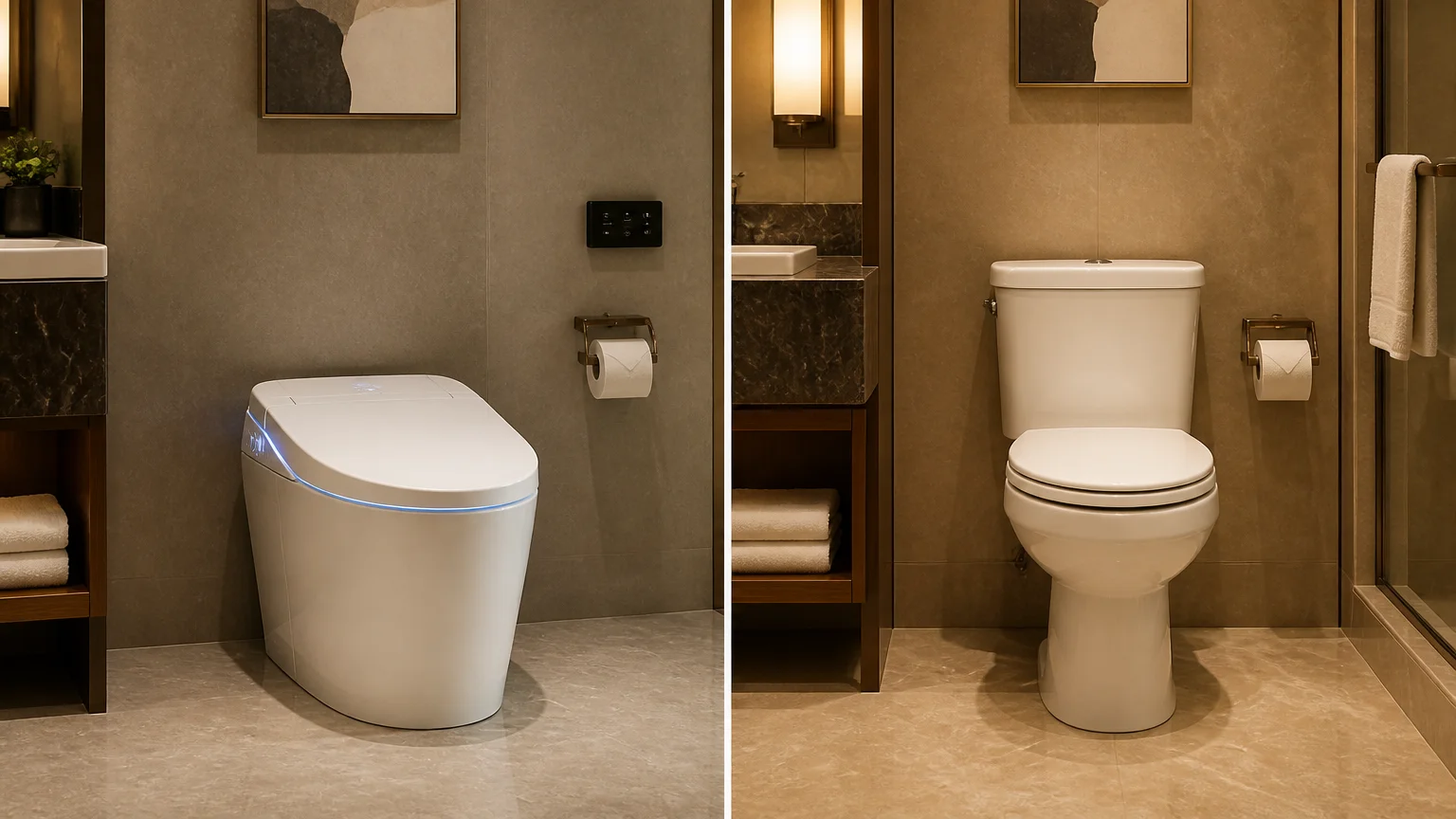
Smart Toilet vs Traditional Toilet: Total Cost for Buyers
Compare smart toilets and traditional toilets across upfront cost, water savings, maintenance, and lifetime ROI for hotel, multifamily, and commercial projects.
Key takeaways
- Smart toilets use 1.28 GPF or less versus 1.6+ GPF for traditional units — water savings compound over the fixture's lifespan.
- Installation adds 20–40% to project cost for smart toilets due to electrical work; budget this before comparing unit prices.
- Warranty coverage matters more than upfront price. A 2-year warranty with free replacement parts shifts maintenance cost from buyer to supplier.
- US warehouse fulfillment removes the container commitment — test one unit before scaling.
B2B sourcing checklist
Move from research to a model-specific quotation
Use the resources below to confirm specifications, compliance scope, order terms and delivery timing before requesting a quote.
A traditional commercial toilet costs less to buy. A smart toilet costs less to operate. The question for a hotel, multifamily, or commercial buyer is not which one is cheaper — it is at what point the operating savings overtake the upfront premium.
This comparison covers the four cost layers that determine the real answer: unit price, installation, operating costs, and maintenance.
Unit price: the number on the quote
| Tier | Traditional toilet | Smart toilet (integrated) |
|---|---|---|
| Entry-level | $100–$300 | $500–$800 (retrofit seats) |
| Mid-range | $300–$800 | $1,200–$2,500 (integrated) |
| Premium | $800–$1,500+ | $4,000–$7,000+ |
For a 100-room hotel, the mid-range comparison is the relevant one: roughly $50,000 for traditional fixtures versus $150,000 for smart toilets. The $100,000 difference is the number that gets attention — but it is not the number that determines the outcome.
Installation: the line item most budgets miss
A traditional toilet installs in 1–2 hours with basic plumbing labor. A smart toilet adds electrical work: a dedicated GFCI outlet, possibly a new circuit, and verification against local code.
| Installation component | Traditional | Smart toilet |
|---|---|---|
| Plumbing labor | $150–$300 | $150–$300 |
| Electrical (new GFCI outlet/circuit) | Not needed | $150–$500 |
| Total per unit | $150–$300 | $300–$800 |
For a multi-unit project, installation adds 20–40% to the total project cost above the unit price. Budget the electrical work before comparing unit prices — a $1,200 smart toilet with a $500 electrical rough-in is a $1,700 installed cost, not $1,200.
Operating costs: where the math shifts
Water
A traditional commercial toilet uses 1.6 gallons per flush (GPF) or more. Smart toilets in the Lavilys smart toilet range use 1.28 GPF maximum — the A17 and A18 are documented at 4.8 L / 1.27 GPF. The difference per flush is small. Multiplied by the flushes in a 100-room hotel over a year, it is not small.
A hotel averaging 1.5 guests per room and 5 flushes per guest per day runs roughly 273,750 flushes per year. At 1.6 GPF, that is 438,000 gallons. At 1.28 GPF, it is 350,400 gallons — a difference of 87,600 gallons annually. At the US average commercial water rate of approximately $4 per 1,000 gallons, that is about $350 per year. Over a 15-year fixture lifespan: $5,250.
The water savings alone do not justify the upfront premium. But they are not the only operating variable.
Consumables and cleaning
Bidet-equipped smart toilets reduce toilet paper consumption. For a hotel, toilet paper is a material operating cost. A 60–80% reduction per room shifts the housekeeping budget — not dramatically, but cumulatively across 100 rooms over 15 years, it is measurable in the tens of thousands of dollars.
Self-cleaning nozzles and rimless bowl designs reduce cleaning labor time per room. If a housekeeper saves 30 seconds per bathroom on a 100-room property, that is roughly 50 minutes per day — approximately 300 hours per year — of labor reallocated to higher-value tasks.
Maintenance and warranty: the layer most buyers overlook
Traditional toilets have mechanical components — flappers, fill valves, seals — that any plumber stocks and replaces in 30 minutes. Parts cost $10–$50. Downtime is measured in hours.
Smart toilets have electronic components — control boards, heating elements, sensors, pumps — that are model-specific. A failed heated seat or control board requires the correct replacement part from the supplier.
This is why warranty terms matter more than the unit price. A supplier who provides a 2-year warranty with free replacement parts and US-based stock absorbs the maintenance cost during the coverage period. A supplier who provides a 1-year warranty with parts shipped from overseas transfers both the cost and the downtime risk to the buyer.
Lavilys provides a 2-year warranty on the complete unit. Quality defects are the seller’s responsibility. Replacement parts ship from US warehouses — no international freight, no customs delay.
For full warranty details, see the product support and after-sales page.
The timeline: when each makes sense
| Scenario | Recommendation |
|---|---|
| New hotel construction | Smart toilets in guest rooms (mid-range integrated, one standardized model). Traditional in public restrooms and staff areas. |
| Hotel renovation | Smart toilet seats on existing ceramic where the bowl is in good condition. Full integrated replacement where plumbing is already being reconfigured. |
| Multifamily development | One smart toilet model across all units for specification consistency. Tanked models (W1, K1) where low water pressure is a known issue. |
| Single showroom evaluation | Order one unit from US warehouse stock — no container commitment. Test with real customers, then scale. |
The test-before-you-commit model
The traditional sourcing path for a commercial buyer committing to smart toilets required a container order, a production lead time, sea freight, and customs clearance — before a single unit could be evaluated in the actual installation environment.
That model is no longer the only option. Lavilys stocks inventory at two US warehouses — West Coast (City of Industry, CA) and East Coast (Jackson Township, NJ). A buyer can order one unit, ship it domestically, install it in a sample room, and verify fit, function, and guest response — all before placing a volume order.
Request a showroom unit at wholesale pricing. No minimum order.
Related pages
Referenced models
Products discussed in this article
A17 Integrated Smart Toilet
U-shaped integrated smart toilet with siphon jet flushing, foot-sensor operation and a full comfort function set — CUPC, UL and FCC certified for the North American market.
View specifications Smart ToiletA18 Integrated Smart Toilet
A17 sibling with microwave-sensing auto lid and foot-sensor operation — adds hands-free open/close for hospitality and premium residential use.
View specifications Smart ToiletW1 Integrated Smart Toilet
A compact 110V integrated model with direct side control, temperature feedback and a documented comfort function set.
View specifications Smart ToiletK1 Integrated Smart Toilet
110V integrated smart toilet with remote and side-knob control, automatic lid and flush functions, and a documented four-level comfort system.
View specificationsNext step
Send us the project details
Share the market, quantity, site conditions and documentation you need. Our technical team confirms configuration and compliance scope before anything is quoted.