
Buyer Guide / 6 min read
Smart Toilet Voltage Requirements for North America
Specify 110–130V smart toilets for US and Canadian projects, including GFCI protection, grounding, circuit load, cord reach and the data required for an RFQ.
Key takeaways
- Our North American configurations are documented at 110V or 100–130V AC, 50/60Hz — never assume a 220V unit can be adapted on site.
- Rated power spans roughly 1,100–1,260 W with peak draws up to about 1,800 W, so plan a dedicated GFCI-protected bathroom circuit.
- Power cords are 1 m to 1.5 m, which decides where the outlet has to sit before the wall is closed.
- The W1 and K1 records each list two rated-power figures, so the final electrical rating is a quote-stage confirmation item.
B2B sourcing checklist
Move from research to a model-specific quotation
Use the resources below to confirm specifications, compliance scope, order terms and delivery timing before requesting a quote.
For US and Canadian projects, specify a smart toilet documented for 110–130V AC and install a grounded, GFCI-protected supply within the model’s cord reach. Do not approve a 220V unit on the assumption that it can be converted on site.
This guide covers circuit load, grounding, GFCI protection, outlet position and the information required before quotation. For the full model range, start with the smart toilet category; for retrofit seats, the seat category compares the two formats, and technical downloads provides available model files.
Start from the documented supply, not the region
Voltage is a per-model configuration, not a company-wide setting. The records for our current catalogue read as follows.
| Model | Documented supply | Rated power |
|---|---|---|
| A17 / A18 | 110–130V | 1,100 W rated / 1,600 W maximum |
| S21G | AC 110V / 60Hz | See model manual |
| W1 | 110V AC ±10%, 50/60Hz | 1,260 W (manual) / 1,360 W (parameter graphic) |
| K1 | 110V ±10%, 50/60Hz | 1,260 W (manual) / 1,350 W (parameter image) |
| 6293 | 110V AC ±10%, 50/60Hz | 1,260 W (manual) |
| T1 bidet seat | 110V AC, US plug | 1,200 W |
| B04 bidet seat | 100–130V AC, 50/60Hz | 1,260 W rated, ≤1,800 W maximum |
Two things in that table matter more than the numbers themselves.
First, the ±10% tolerance on the integrated models means a nominal 120V North American supply sits comfortably inside the working window, while a 220–240V supply does not — there is no site-side workaround, because the heater, pump and control board are all built for the stated range. A step-down transformer is not an acceptable substitute for the correct factory configuration on a project we are asked to support.
Second, the W1 and K1 source packs each list two different rated-power values. We publish both rather than picking the more convenient one. Treat the final electrical rating as a confirmation item at quote stage, especially if your electrical engineer is sizing circuits close to a limit.
Size the circuit for a heater, not for a toilet
An instant-heating unit draws its peak current in short bursts while washing water is heated on demand. At a nominal 120V supply:
- 1,100 W is roughly 9.2 A
- 1,260 W is roughly 10.5 A
- 1,360 W is roughly 11.3 A
- 1,800 W peak is roughly 15 A
A single unit on a dedicated 15 A or 20 A branch circuit is the straightforward answer. What causes trouble is a shared circuit — a bathroom receptacle circuit already carrying a hair dryer, a towel warmer or a second bathroom is where nuisance tripping starts. In multi-unit residential and hotel work, the electrical drawing should show the smart toilet outlet as its own load, and the schedule should note the peak figure rather than the average.
For Canadian projects, remember that the electrical review is a separate exercise from the plumbing review even when both are in the same submittal package.
Grounding, GFCI and the wet-room rules
Every model in the catalogue is built for a grounded three-prong supply. The K1 manual is explicit on two points that apply across the range: install on a grounded 110V supply, and do not use an extension cord. Both instructions exist because the appliance combines mains heating with water.
Bathroom receptacles in the United States are required by the National Electrical Code to be GFCI-protected, and Canadian practice under the CEC is equivalent. This is a long-standing rule, not a new one — GFCI protection has been required in bathrooms since the 1975 edition of the NEC, and the Electrical Safety Foundation International credits it with an 80% drop in electrocutions since then. See the ESFI overview of GFCI protection for the background. Confirm three things with the electrician of record:
- The receptacle serving the unit is GFCI-protected, and the protection device is accessible for testing.
- The receptacle is grounded and tested — not simply a three-slot face on an ungrounded circuit, which is a common finding in older housing stock.
- The outlet is outside the direct splash zone but within cord reach.
On the product side, the units carry their own protection layers: leakage protection, temperature sensing and high-temperature cut-off appear in the K1 and W1 material, IPX4 water protection is documented on 7 of the 11 current models, and the T1 seat uses a 12V safety voltage on its low-voltage side with flame-retardant housing material.
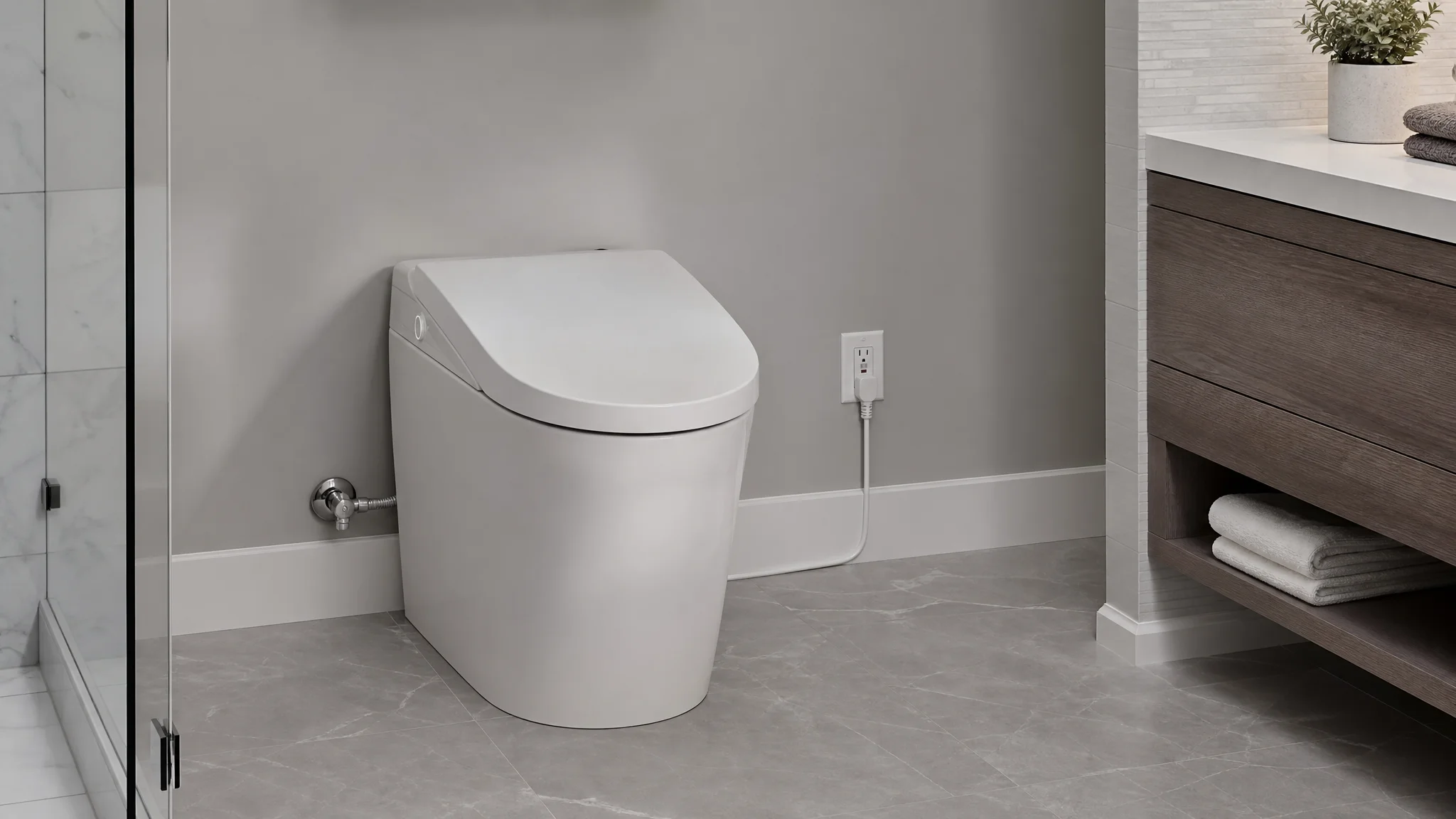
Cord length decides the outlet position
This is the detail that gets missed on drawings and discovered on site. Documented cord lengths:
- S21G: approximately 1 m (39.37 in)
- A17 / A18: approximately 1.2 m (48 in)
- W1 and K1: 1.5 m
- T1 seat installation guide: socket within approximately 1.5 m, water inlet valve within approximately 0.5 m
A 1 m cord on a unit whose inlet is at the left rear does not reach an outlet placed by habit on the opposite wall. For new construction, fix the outlet position in the rough-in drawing beside the drain and the angle valve. For retrofits, photograph the existing outlet and valve positions with a tape measure in frame before the order is approved — that single photo resolves most later disputes.
50 Hz, 60 Hz and mixed-market orders
Most of the range is documented at 50/60Hz, which simplifies orders that span markets. The S21G, however, is documented specifically at 60Hz. If one purchase order serves both a North American and a 50 Hz market, split the electrical configuration by destination in the order lines rather than assuming a single SKU covers both, and ask us to confirm the plug type and certified electrical version per destination.
The electrical review checklist
Send these five items with your enquiry and we can complete an electrical review in one pass rather than three:
- Destination market and nominal supply voltage.
- Whether the circuit is dedicated, and its breaker rating.
- GFCI protection method — receptacle or breaker.
- Outlet position relative to the drain, with the distance to the angle valve.
- Quantity per configuration, so the correct plug and certified electrical version is quoted per line.
For unit-level electrical data, the K1 and W1 records publish the full parameter tables, and the T1 and B04 seat records include their installation environment requirements. Manuals for those models are in technical downloads. The related rough-in and compliance guides — 300 mm vs 400 mm and how cUPC, WaterSense, UL and FCC differ — cover the plumbing and listing side of the same approval file.
If the site conditions are unusual — an ungrounded circuit, a shared bathroom circuit at capacity, or a market whose plug standard is not in the list above — send the details to our technical team with photos, and we will confirm what can be configured before anything is quoted.
Frequently asked questions
Do smart toilets in the United States need a GFCI outlet?
Yes. A smart toilet is a mains-powered appliance installed in a wet room, so the project should provide grounded GFCI protection in accordance with the applicable electrical code and the model instructions.
Can a 220V smart toilet be converted for a 120V bathroom?
Do not plan a site conversion. Select a model and configuration already documented for the destination voltage, frequency and plug type.
What electrical information belongs in an RFQ?
Provide the country, nominal voltage, frequency, breaker rating, GFCI method, outlet position and quantity per configuration. Attach photographs or drawings through the technical review form when the existing circuit is uncertain.
Related pages
Referenced models
Products discussed in this article
K1 Integrated Smart Toilet
110V integrated smart toilet with remote and side-knob control, automatic lid and flush functions, and a documented four-level comfort system.
View specifications Smart ToiletW1 Integrated Smart Toilet
A compact 110V integrated model with direct side control, temperature feedback and a documented comfort function set.
View specifications Bidet Toilet SeatT1 Bidet Toilet Seat
A V-shaped upgrade seat with instant water heating, adjustable washing and a direct side-control experience.
View specifications Bidet Toilet SeatB04 Electric Bidet Seat
Elongated electric bidet seat with side-knob washing control, soft-close lid and model-dependent warm-air drying.
View specificationsNext step
Send us the project details
Share the market, quantity, site conditions and documentation you need. Our technical team confirms configuration and compliance scope before anything is quoted.